Dress codes, explained from the clothes you already own
“Smart casual”, “cocktail”, “black tie optional”: what each one asks for, the one piece that moves you up a step, and what to do when your closet can’t reach it.
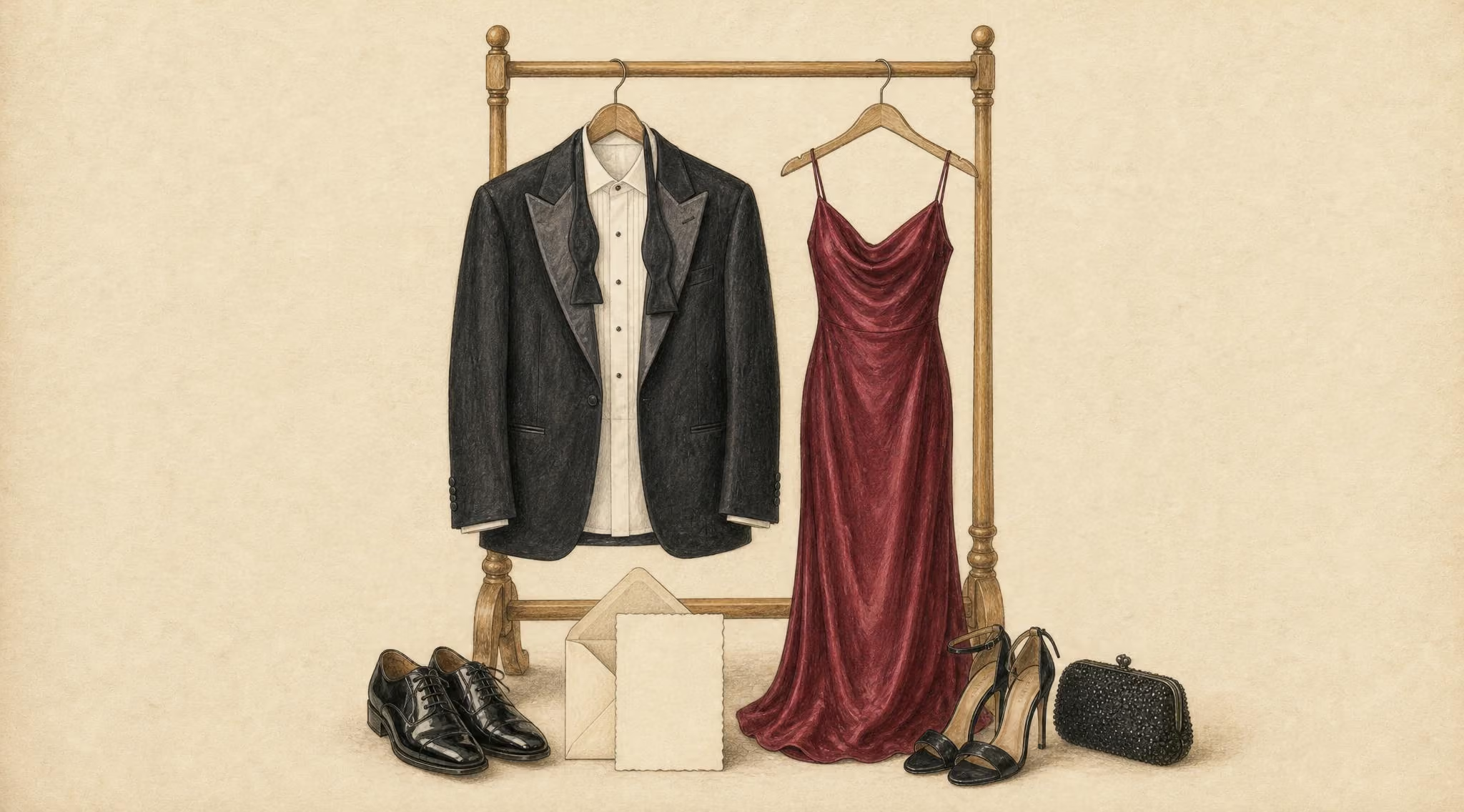
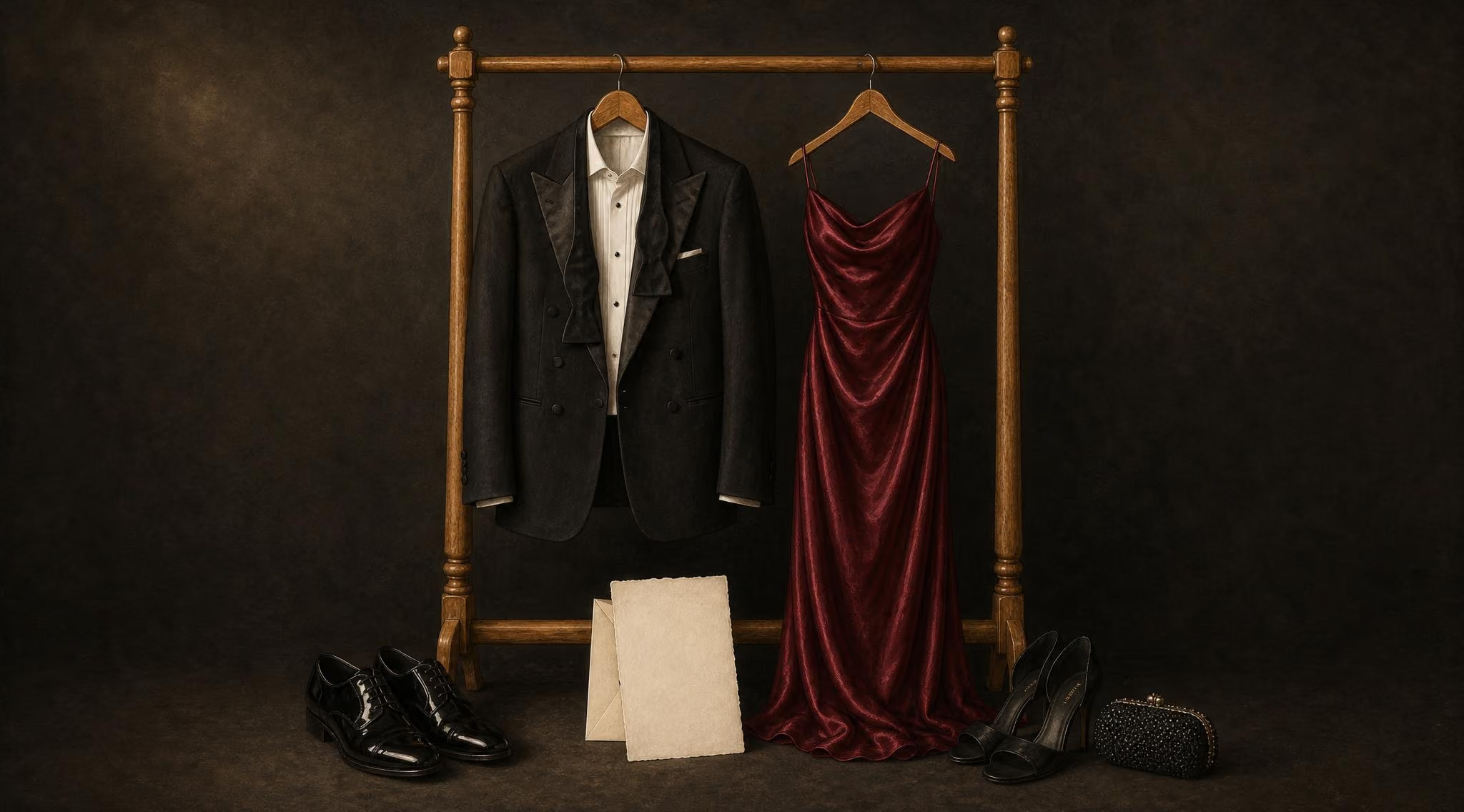
The invitation has been propped against the fruit bowl since Tuesday. The date is fine, the place is fine, and in the bottom corner, smaller than everything else, are two words: smart casual. Or cocktail attire, or black tie optional. Yesterday the wardrobe looked perfectly good. Now every hanger in it looks like a wrong answer.
The words tell you how dressed up the evening will be, if you know the code. They’re English words, and they turn up on invitations well beyond the UK and the US; this piece reads them from two guides that define them, Debrett’s in the UK and the Emily Post Institute in the US. That makes it a reference for the words on the card, not a guide for British and American readers only: wherever the invitation was printed, these are the meanings it’s borrowing. The two guides don’t always agree, and where they differ, this piece says so. Where the rest of Europe keeps customs of its own, the piece goes to the people who set them: governments, universities, balls, opera houses and the Nobel banquet. It starts from the clothes you already own.
The short version
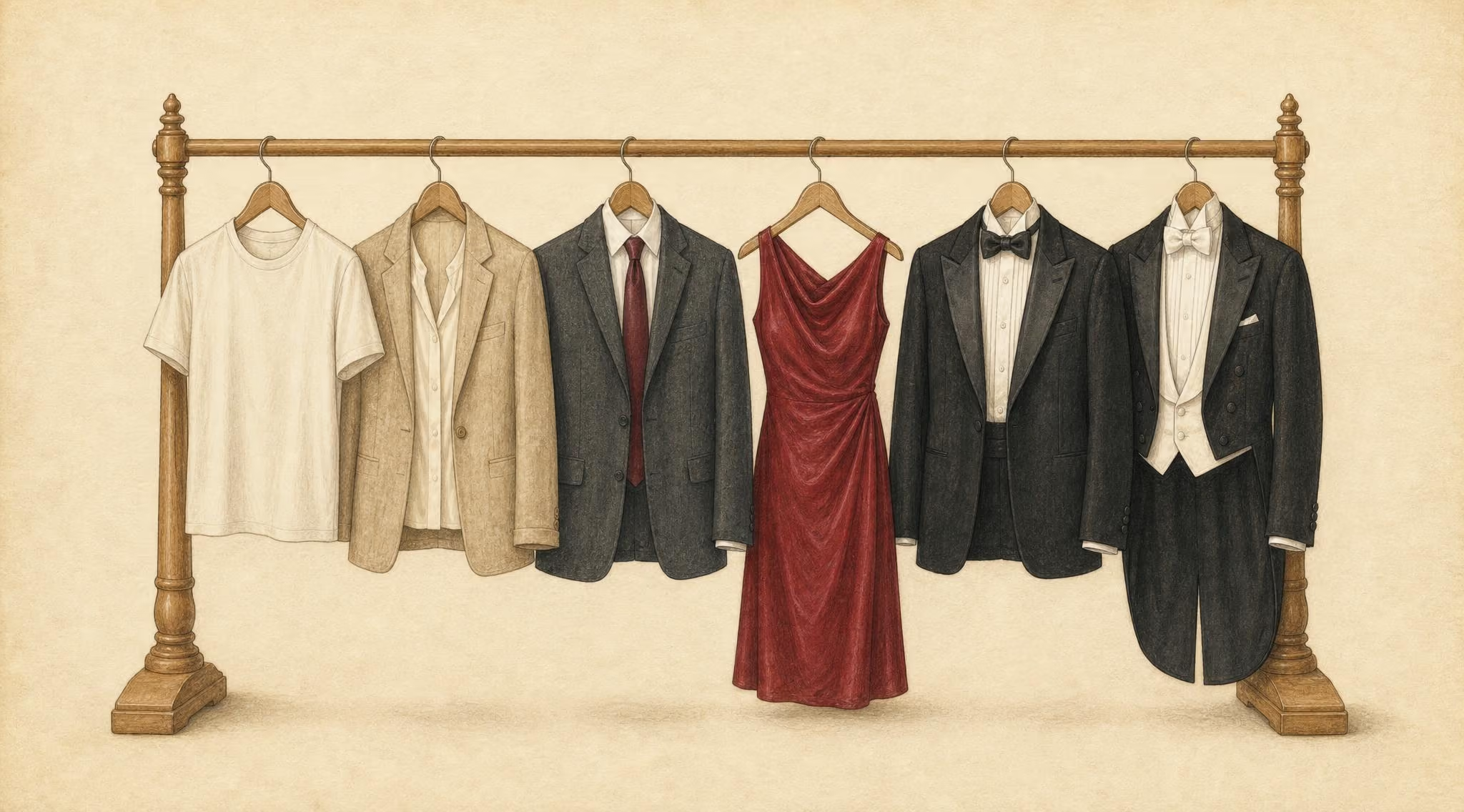
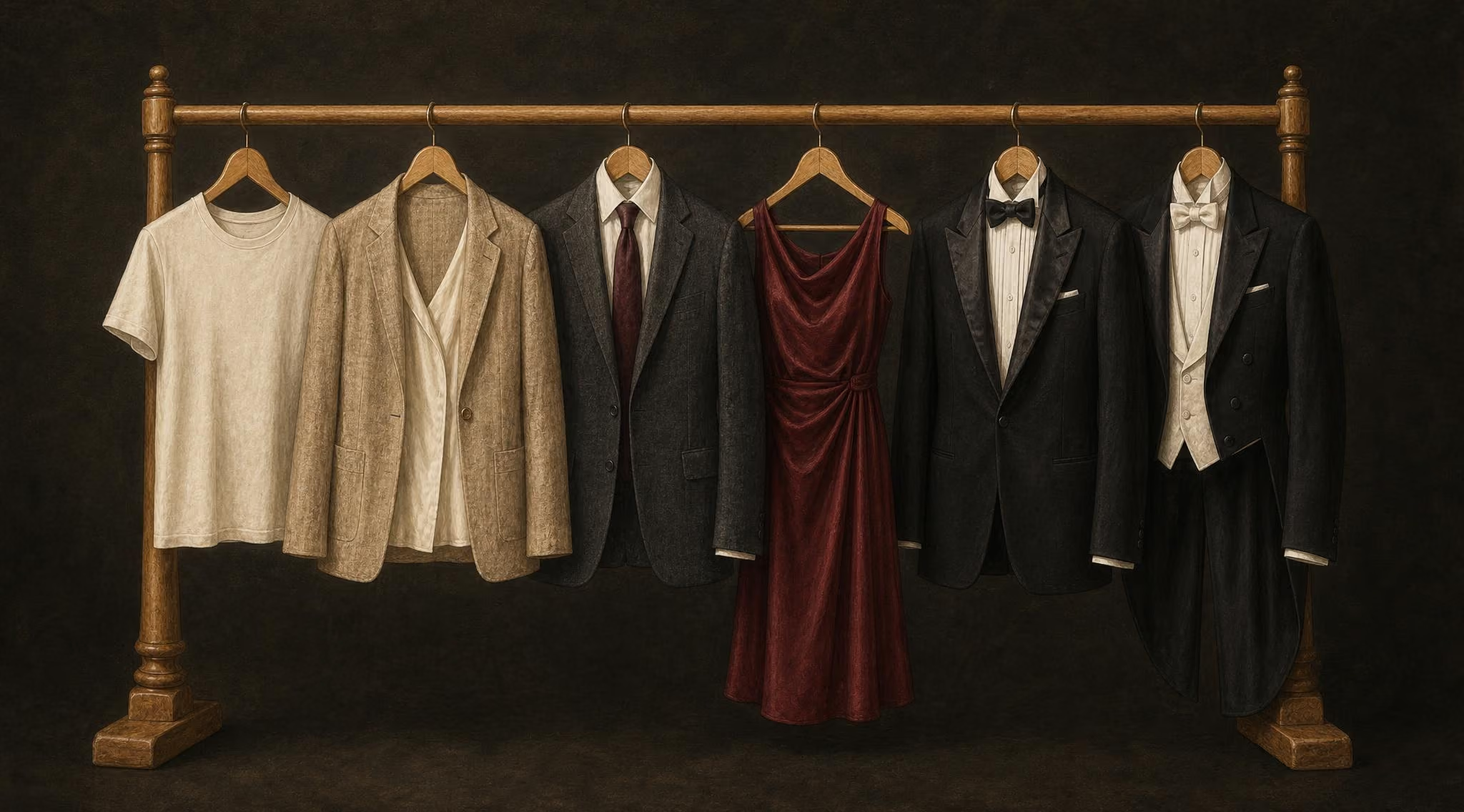
Every dress code sits on one ladder: casual at the bottom, white tie at the top, and a daytime branch, morning dress, for the most formal weddings and race days.
Most of the steps are one piece apart: a jacket and leather shoes from casual to smart casual, a matching suit and a tie to lounge suits, then a dress or an evening fabric to cocktail, while the suit stays as it is. Only near the top is the step a garment most wardrobes don’t hold.
So the question is rarely “what do I need to buy?” but “which rung is this, and which piece gets me there?” Usually the piece is already in the wardrobe, and if it’s one of those kept for occasions that hardly ever come off the hanger, this is what it’s for.
The ladder
Seven rungs, casual to white tie, then the daytime exception.
Casual
An American code. Emily Post calls it “informal and comfortable, yet clean and professional”: nice jeans or khakis, a plain T-shirt “(no slogans)”, a polo or a casual blouse, a sundress, and “Loafers, sneakers (with or without socks), sandals”. Debrett’s has no casual code, and can’t settle “come as you are”: one of its pieces says a relaxed host can mean jeans and flip-flops by it, while its guide warns that “‘Come as you are’ rarely means what it says”.
The step up: a collar instead of a T-shirt, a jacket, and leather shoes instead of trainers.
Smart casual, dressy casual and business casual
Three names for neighbouring spots on one rung: smart casual (British, social), dressy casual (American, social) and business casual (American, for work). Neither authority groups them like this; it’s a way to hold them in your head, not a rule.
Smart casual, in Debrett’s words, is “simply a plea from a host to guests requesting them not to turn up in everyday ‘leisure’ clothes”, and “In essence, this is not business attire”. In men’s clothes, “a jacket or blazer, flannels, needlecord trousers, or chinos (not jeans), a shirt with a collar”. In women’s, a smart day dress with a jacket at the formal end, smart trousers or a skirt with a cardigan at the casual end.
Dressy casual is Emily Post’s alone: “a versatile balance between formal and casual”. A blazer and slacks, tie optional; or a dress, dressy trousers, or “Nice jeans and dressy top”.
Business casual is, for Emily Post, “about one notch down the formality chain from the usual expectations”. Where suits are the norm, that means a jacket and no tie; where they aren’t, a jumper, chinos and “casual leather shoes or well kept sneakers”. And above all: “Always check and abide by your company’s dress code”.
From an ordinary wardrobe, almost anyone can reach this rung: a jacket or blazer over what you’d wear anyway, a collar, leather shoes; or a dress or smart trousers with a jacket or a cardigan. Denim only if it’s dark and tailored.
The step up: a matching suit, and a tie if you wear one; or tailored pieces, such as a trouser suit, a skirt suit, or a dress with a jacket.
Most steps on the ladder are one piece apart.
Lounge suits, or business attire
A British name “only seen on invitations”, Debrett’s says; in conversation, people say a dark suit. In men’s clothes, a suit, shirt and tie, with “formal, polished, black shoes”. In women’s, by day “a day dress, trouser suit, or skirt and jacket or coat”; in the evening “a smart, or cocktail, dress (with sleeves or a jacket)”. Emily Post’s match is business formal, where “The darker the suit, the more formal.”
From an ordinary wardrobe: anyone with a work suit already has it, and a dress with a jacket covers it too.
The step up: in men’s clothes, often nothing. The next rung changes the dress, not the suit.
Cocktail, semi-formal and festive
These three sit side by side; neither authority ranks cocktail against semi-formal.
Cocktail is the one both countries use. Debrett’s treats it as a softer alternative to black tie, a code that will “release guests, especially men, from rigid strictures”: a smart suit, a velvet jacket or a Nehru jacket, or “whatever dress/trouser combination they feel will make them look chic and glamorous.” Emily Post has no separate cocktail code; the cocktail dress sits inside its semi-formal and festive.
Semi-formal is American: “more formal than what you would wear to an office, but slightly less formal than what you would wear to a formal event”. In men’s clothes, Emily Post asks for the same dark suit and tie as business formal. The difference is in women’s: a “Short afternoon or cocktail dress”, a little black dress, or dressy separates.
Festive is the American holiday version, “essentially cocktail party attire with a seasonal and festive holiday touch”: a cocktail dress or dressy separates in holiday colours, or a blazer with a festive tie. That blazer is where the two authorities part: Debrett’s cocktail means a suit or a velvet jacket, a step above it.
For an office party, Debrett’s says “The key thing is to change for the event and not to wear work clothes”; for a party held at the workplace itself, Emily Post says people “can simply show up in the clothes they have worn all day”.
From an ordinary wardrobe: in men’s clothes, usually the suit from the rung below, or a blazer for festive. In women’s, a cocktail dress or evening separates.
The step up: the host’s “black tie optional”, or black tie itself.
Black tie optional
An American code. Emily Post: “Men are requested to wear a tuxedo, but can opt for a dark suit”, with a white shirt and a “conservative tie”; or “a formal evening gown, a shorter cocktail dress, or dressy separates.” Debrett’s doesn’t use it. “Black tie preferred” is defined by no etiquette authority; the plain reading is that the host leans harder towards black tie, so if you’re unsure, ask.
From an ordinary wardrobe: your darkest suit, a white shirt and a plain dark tie meet it, by Emily Post’s own words. It sounds out of reach, and it isn’t.
Black tie
Debrett’s calls it “the most frequently encountered formal evening wear”, and it was once the relaxed option: “only a couple of generations ago white tie was standard evening dress and black tie was considered informal”. The jacket is a dinner jacket in the UK and a tuxedo in the US.
In men’s clothes, Debrett’s asks for a black dinner jacket with silk lapels, a white evening shirt with a “turn-down collar (not a wing-collar)”, and “A black hand-tied bow tie (avoid ones which are pre-tied)”. Emily Post adds a cummerbund, which Debrett’s says is not essential.
In women’s clothes, Debrett’s says “long, or at least not very short, is usually best”, or a cocktail dress “to very slightly below the knee” in silk, crepe or chiffon, or evening trousers. And colour isn’t the point: “dresses need not be black. Equally, wearing black does not ensure the right level of formality”.
Creative black tie loosens it, and the two disagree on how far: Emily Post says “It maintains black tie formality”, with a coloured bow tie or a black shirt; Debrett’s allows a necktie and a velvet smoking jacket.
From an ordinary wardrobe: in women’s clothes, usually reachable: a long dress, your dressiest dress in an evening fabric, or evening trousers. In men’s clothes, this is the first rung most wardrobes can’t reach, and the step is one garment: the dinner jacket, with its bow tie.
White tie
White tie, in Debrett’s words, is “the most formal of dress codes and is not common today”, and “‘White tie’ will always be stated on the invitation itself.” In men’s clothes, a tailcoat “worn unbuttoned”, a wing collar, a white waistcoat and “A thin, white hand-tied marcella bow tie”. In women’s: “Full-length, formal evening dresses … Shorter dresses or trousers, no matter how smart, are not acceptable.”
From an ordinary wardrobe: almost nobody. Hire, or take the way down many hosts now offer, “white or black tie”, and go in black tie.
Morning dress, by day
Morning dress is British, the daytime counterpart of black and white tie, and never for an event starting after 6pm. It’s worn at weddings, formal memorial services, the Royal Enclosure at Ascot, the Derby and royal garden parties. In men’s clothes, a morning coat, grey or striped trousers and a waistcoat. In women’s, a dress, or a skirt with a jacket, and “Hats are usual”; since “the upper body should be covered for day events”, no cocktail dresses or low necklines.
The most useful British fact here is about weddings: “If no reference is made to dress code on a formal invitation, then morning attire should be worn. Black tie or suits should be specifically mentioned”. The Debrett’s page it comes from carries no date. The US has no morning dress; for a formal daytime wedding, Emily Post’s answer in men’s clothes is a “Dark suit; conservative shirt and tie”.
From an ordinary wardrobe: in men’s clothes, the morning coat is another garment most wardrobes don’t hold; what to do about that is further down.
Try it
Which rung is my invitation?
What does the invitation say?
UK
Not your weekend clothes, and not a suit either.
- Up a step: a matching suit and a tie, or a trouser suit or a dress with a jacket — lounge suits.
- Down a step: lose the jacket and the collar — casual.
- From your closet: a jacket or blazer, chinos or smart trousers, a shirt with a collar and leather shoes; or a day dress with a jacket, or smart trousers or a skirt with a cardigan, and flats or loafers. Dark, tailored jeans only at the relaxed end.
Debrett’s has eased over the years: by 2025 it allowed tailored jeans, and smart trainers at the relaxed end. It’s usually a daytime code; in the evening, dress up a notch.
From Debrett’s and the Emily Post Institute, read 2 November 2026. Nothing you tap leaves this page.
Where the line moves
The rungs are the easy part. What moves is everything around them.
The country. The same thing has two names, lounge suits and business attire, dinner jacket and tuxedo, and most codes on the ladder are defined in only one country.
Elsewhere in Europe. The top rung is far from retired. White tie is still required at the Nobel banquet in Stockholm, where “Gentlemen are required to wear white tie and tails, while ladies should be dressed in an evening gown”, and at the Vienna Opera Ball, which asks men for a tailcoat and white bow tie; Vienna’s other traditional balls take “a tuxedo or tails”. In the north, the stand-in for white tie is the suit already in the wardrobe, not a dinner jacket: Finland’s Independence Day reception asks for “white tie and tails, a dark suit, or a uniform corresponding to formal dress”, and adds, “Tuxedos are not worn”. National costume counts too; at the Nobel banquet it is “an alternative to white tie and tails or evening gown”. White tie even comes out by day: in Finland, “At events beginning before 6 pm, the tailcoat is paired with a black waistcoat.” Opera houses are gentler than their reputation. La Scala asks only that people dress “in keeping with the decorum of the Theatre”, and Barcelona’s Liceu has “no mandatory or formal dress code”; even on gala nights, “admission is not denied to those who do not wear them”.
The time of day. Morning dress “should not be specified to be worn at an event starting after 6pm”, Debrett’s says, while Emily Post’s semi-formal tips the other way after dark: “later than 6 in the evening … err on the side of formality”. For Debrett’s, smart casual is “usually a dress code for daytime events”; in the evening, women’s clothes may move up, to “a cocktail dress, more jewellery and higher heels”. And Emily Post’s rule for length: “Long dresses and skirts are fine for any wedding from noon on”.
The card and the place. Debrett’s again: “A printed invitation suggests a smarter event than a text or email”, and town is smarter than country.
The year. Debrett’s has relaxed. In 2023 it called denim “probably too casual”; by 2025, in women’s clothes, it was “fine to wear jeans, as long as they’re tailored and well-fitted”. In 2022 it wanted “leather shoes, not trainers”; by 2025, at the informal end, “smart trainers or deck shoes rather than flip-flops or sandals”. No one year is the right one; it’s the same authority, loosening as it goes.
The host. Whatever any guide says, this one included, the host’s own words win.
When your closet can’t reach it
Near the top, a few rungs ask for a garment most wardrobes don’t hold. In men’s clothes that’s black tie, white tie and morning dress; in women’s, black tie is usually reachable and white tie is full length only. None of that is about your wardrobe. It’s just where those rungs are.
- Hire. For a single evening, hiring is a perfectly good answer.
- Borrow. From a friend or a sibling your size: a fine thing to borrow for one evening, and a fine thing to lend.
- Ask. A host who writes “white or black tie” already knows the top rung is hard for some guests. If the card offers no way down, asking costs one line.
And sometimes the right answer is to own it. If black-tie evenings come round several times a year, a dinner jacket of your own can be the right call, and Thirty wears is the way to tell: count the evenings honestly, and decide whether that’s enough.
When to ask, and how
Both authorities say you can. Debrett’s says “you can always ask the hostess”, and that “a quick text or email is probably fine”; or ask a fellow guest first, “before you fly into a blind panic and contact your host”. Emily Post makes it part of saying yes: “If you are not sure what to wear, ask the organizer when you RSVP”. So send the yes, and put the question in the same message:
“Thank you, I’d love to come. Quick question so I get it right: is ‘cocktail’ suits and ties for this one, or a bit more relaxed?”
Swap in the words on your own card.
When you can’t ask, go over rather than under: “it’s preferable to look over-, rather than under-dressed”, Debrett’s says, and with no traditional code given, “err on the side of formality”. A tie works in both directions, since “Men may wish to remove their tie on arrival if others are more casually dressed”. The one exception is a drinks party with no code at all, where guests “will default to smart casual clothing”.
Sources
- Debrett’s, “Events and Dress Codes”, read 2 November 2026.
- Debrett’s, “Deconstructing Dress Codes”, read 2 November 2026.
- Debrett’s, “Do Dress Codes Matter?”, read 2 November 2026.
- Debrett’s, “Addressing the Dress Code”, read 2 November 2026.
- Debrett’s, “Interpreting Invitations”, read 2 November 2026.
- Debrett’s, “A World of Formality”, read 2 November 2026.
- Liz Wyse, “Weddings”, Debrett’s heritage article, undated, read 2 November 2026.
- Emily Post Institute, “Attire Guide: Dress Codes from Casual to White Tie Formal”, read 2 November 2026.
- Emily Post Institute, “Black Tie Dress Code: Our Comprehensive Guide”, read 2 November 2026.
- Emily Post Institute, “Business Casual 101: Everything You Need to Know”, read 2 November 2026.
- Emily Post Institute, “Wedding Guest Attire: What to Wear to a Wedding”, read 2 November 2026.
- Emily Post Institute, “Wedding Attire: Tips for the Moms”, read 2 November 2026.
- Emily Post Institute, “Download: 11 Tips for Surviving the Office Holiday Party”, read 2 November 2026.
- Emily Post Institute, “Dressing for the Occasion: The Office Party”, read 2 November 2026.
- Nobel Prize Outreach, “The Dress Code at the Nobel Festivities”, read 2 November 2026.
- Vienna Opera Ball, “The Evening”, read 2 November 2026.
- Vienna Tourist Board, “Viennese balls”, read 2 November 2026.
- Office of the President of the Republic of Finland, “Frequently asked questions about the Independence Day reception”, read 2 November 2026.
- University of Helsinki, “What to wear at University of Helsinki events”, read 2 November 2026.
- University of Gothenburg, “Hedersdoktorer, promotorer och vanliga frågor”, in Swedish, read 2 November 2026.
- Store norske leksikon, “galla”, in Norwegian, read 2 November 2026.
- Swiss Armed Forces, Military Protocol, “Allgemeine Kleidungsvorschriften”, in German, read 2 November 2026.
- Belgian Federal Public Service Foreign Affairs, Protocol, “How to wear Belgian National Orders”, read 2 November 2026.
- Boletín Oficial del Estado, “Orden DEF/1756/2016”, in Spanish, read 2 November 2026.
- Teatro alla Scala, “Information”, read 2 November 2026.
- Gran Teatre del Liceu, “Regulations and FAQs”, read 2 November 2026.
Next time the card arrives, tell Dresd’s stylist the two words on it. It builds the look from what’s clean in your closet, and checks the forecast for you.
Get the app